<h1><a name="_vvb0rs62k05u"></a>How To Understand Python Execution Flow: Memory, Threads, And Performance Bottlenecks</h1>
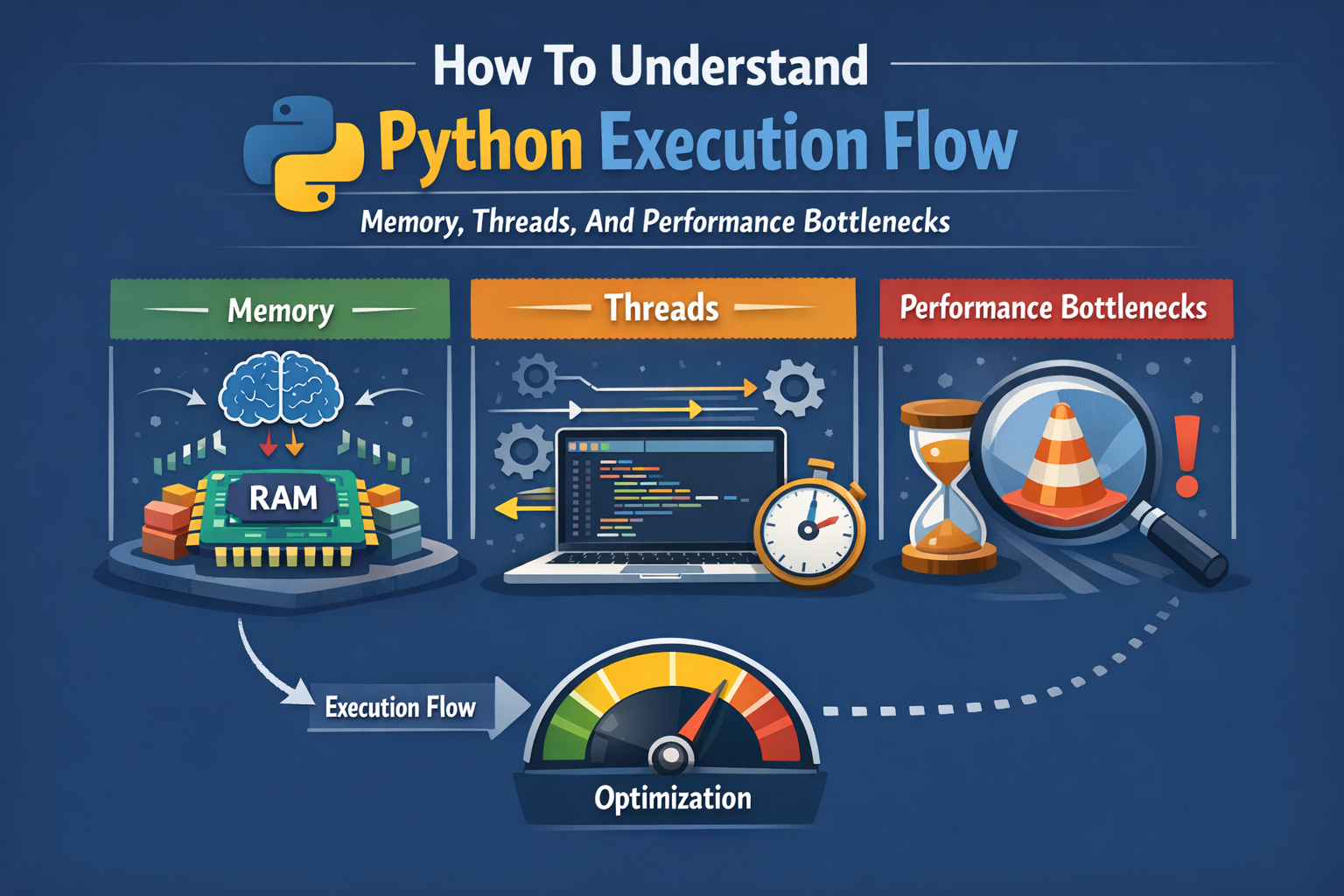
<p>Python is the most known languages for being easy to read and simple to write, but behind a lot happens when a program runs. Every line of Python code follows a clear execution flow that decides how memory is used, how tasks are processed, and where performance may slow down. Understanding this flow helps developers write better code avoiding common issues that appear in real applications.</p>
<p>Learners who begin their journey through <strong><a href="https://www.cromacampus.com/courses/online-python-training-in-india/">Python Online Training in India</a></strong> are often surprised to see how much control they gain. It is not about writing more code, but about writing smarter code that runs remaining stable.</p>
<h2>How Python Executes Code Step by Step?</h2>
<p>When a Python program get started, the interpreter evaluates the source code converting it into bytecode. This bytecode is not machine language but an intermediate form that Python can decode. The Python Virtual Machine then executes this bytecode word to word.</p>
<p>This process explains why Python is flexible and portable across systems. The same code can run on different machines because the interpreter handles execution. However, this flexibility also means that performance depends heavily on how the code is written.</p>
<p>Students in Python Online Training in India learn that execution speed is not only about hardware. It is also shaped by loops, and how objects are created or destroyed.</p>
<h2>Memory Management in Python</h2>
<p>Python manages memory automatically, which is a greatest strength, where developers do not need to allocate memory. Python does this using reference counting and a garbage collection system.</p>
<p>Every object in Python has a reference count, when an object is no longer used, its memory is released. Garbage collection handles cases where objects reference each other without being freed.</p>
<p>During a <strong><a href="https://www.cromacampus.com/courses/python-with-ai-course/">Python with AI Course</a></strong>, learners gets expertise in knowing how memory usage affects large programs. They see how unnecessary object creation, and large data structures can consume memory. By learning how Python stores objects, students write cleaner code that uses memory.</p>
<h2>Threads and the Global Interpreter Lock</h2>
<p>Python supports multithreading, but it works differently compared to some other languages, something called as the Global Interpreter Lock. The GIL ensures that only one thread executes Python bytecode at a time, this design keeps memory management safe. But it also means that CPU heavy tasks do not always run faster. Many beginners expect threads to speed up programs, but it does not.</p>
<p>In <strong><a href="https://www.cromacampus.com/courses/python-training-in-delhi/">Python Training in Delhi</a></strong>, learners experiment with threads and keep and eyes on this behavior. They learn that threading works best for tasks like file handling while waiting for external responses. For heavy computation, other approaches such as optimized libraries is often better choice.</p>
<h2>Common Performance Bottlenecks in Python</h2>
<p>Performance issues usually appear when applications grow handling more data, and some bottlenecks are easy to miss.</p>
<p>One common issue is excessive looping, especially nested loops over large datasets, with repeated calculations. Poor use of data structures can also slow things down, such as dictionaries.</p>
<p>Students during Python Training in Delhi learn become experts in identification of these slow areas by observing runtime. They practice breaking large tasks into smaller steps simplifying logic.</p>
<h2>Function Calls and Execution Cost</h2>
<p>Every function call in Python has a cost, while functions improve readability with many small function calls inside loops.</p>
<p>Learners discover that performance improves when logic is grouped and unnecessary calls are removed. This does not mean avoiding functions entirely, but using them.</p>
<p>Understanding execution flow helps developers balance clean design with efficient execution.</p>
<h2>Input Output and External Operations</h2>
<p>Many performance problems do not come from Python itself, but from operations outside the program. Reading files, and accessing databases all slow down execution, and In Python with AI Course sessions, students learn how to reduce these delays.</p>
<p>Techniques include batching operations, and avoiding repeated file access, these small changes often result in big performance improvements.</p>
<h2>Tools to Understand Performance Better</h2>
<p>Python provides several tools to help developers understand what is happening during execution. Profiling tools show which functions take the most time, where memory tools highlight where memory usage increases.</p>
<p>Learners practice using these tools to inspect real programs, they see clearly which parts of the code matter most with changing brought. This hands on experience gives you the practical exposure building confidence and removing guesswork.</p>
<h2>Writing Better Python Through Understanding Execution</h2>
<p>Once developers understand execution flow, their coding style changes with thinking before adding loops designing programs that scale.</p>
<p>Training programs focus on teaching this mindset early, instead of fixing performance later writing code.</p>
<h2>Conclusion</h2>
<p>Python execution flow is beyond than just running code, which involves memory handling, and many hidden decisions made by the interpreter. When developers understand how Python manages these parts gaining control over performance.</p>
<p>With proper learning through suggested courses, programmers move beyond basic scripting to building applications that run faster.</p>